The Katabast – The Gallery as a Stage
OSTEN Gallery . 26 November – 12 December
Solo exhibition whitin the official programme of the OSTEN Biennial, Skopje.
The Katabast centres on three figures – The Katabast, The Cleancutter and Narcissus – who together form a kind of chamber play. The works move between descent, identity, relationship and reflection, with meaning emerging from the tension between the figures.
A central question concerns the dual nature of the image: its capacity both to hold a state in place and to open it to interpretation. In Narcissus, this becomes particularly clear through the mirror image, which allows presence and loss to coexist within a single image.
The figures remain where they are. The images travel on with us.


Background text
The Katabast – The Gallery as a Stage
The Katabast brings together three figures — The Katabast, The Cleancutter and Narcissus — in a kind of chamber play. They inhabit different situations, but in each case something has already happened. They are bound to their states, their relationships and their memories.
In Alice in Wonderland, Alice arrives at the Hatter’s tea party to find the Hatter, the March Hare and the Dormouse already seated. Time has stopped at six o’clock. It is always tea time. Since there is no time to wash the cups, they keep moving around the table. They move, but get nowhere. Alice asks what will happen when they return to where they began.
The three figures in the exhibition are likewise already there when the viewer enters. Like Alice, the viewer arrives from outside and can ask questions. Unlike the figures, the viewer can leave.
The same structure appears in Dante, who moves through the underworld among figures bound to what they have become. They can speak and remember, but they remain. Dante moves on.
The Katabast belongs to this movement of descent. His name comes from katabasis, the descent into the underworld, a motif that runs from Orpheus and Virgil to Dante: a journey in search of a person, an answer or knowledge.
The figure carries an envelope. It may contain a graduation certificate, a sign of a life about to begin, but it can also be read as a sentence — or the object could be Dante’s Comedy. He is both subject to what awaits him and someone who descends in search of an answer.
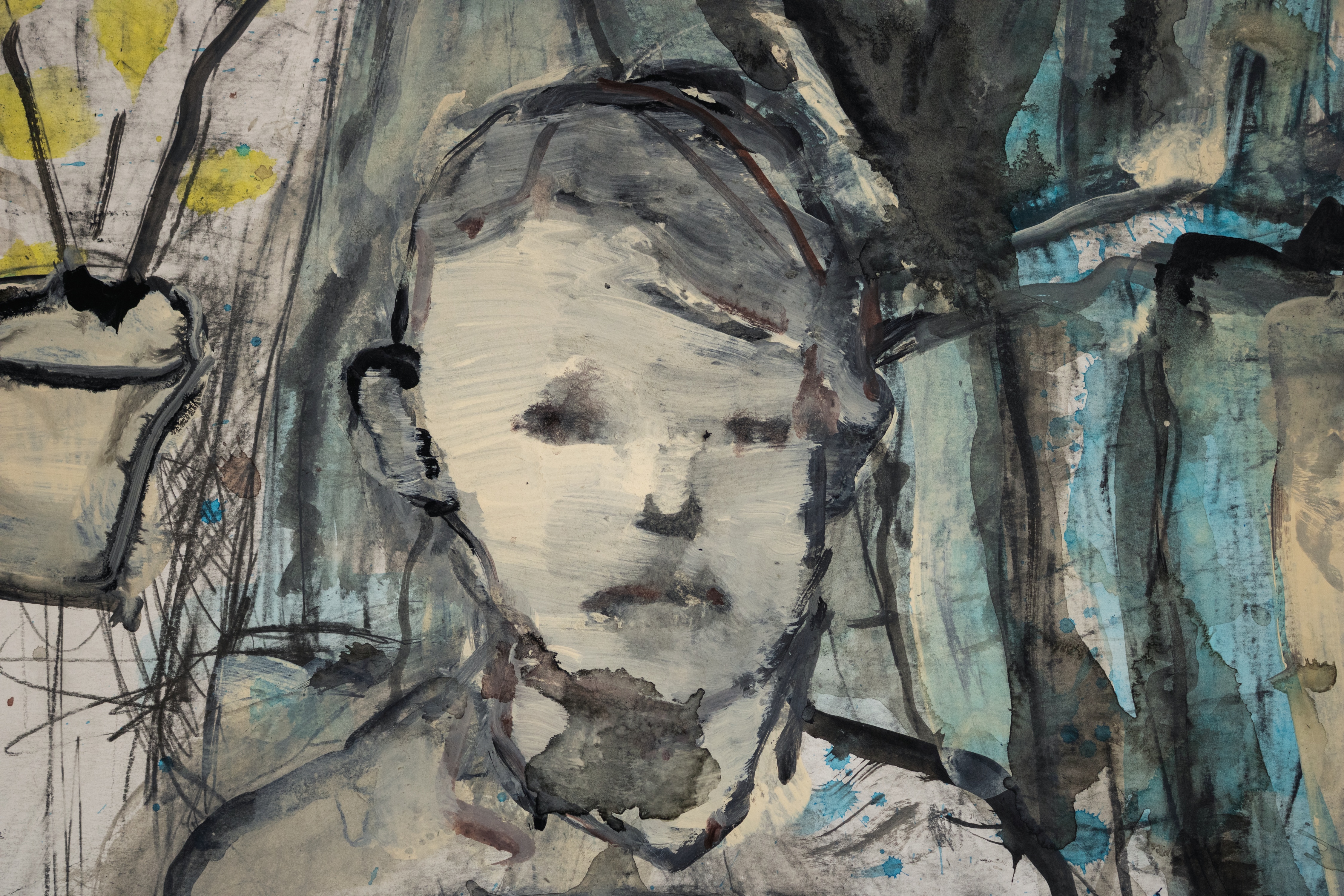
In The Cleancutter, the scene shifts from the underworld to the family. Hair can become a sign of identity, belonging, conformity or resistance. Here, that sign is altered by someone else.
The father holds a mirror. The boy sees himself and the person changing him at the same time. The mirror makes him a witness to his own transformation. The one who looks is also seen.
The mirror links the works. At one point in Dante’s Comedy, figures are mistaken for reflections. In The Cleancutter, the mirror is held between two people. In Narcissus, the water is the mirror.
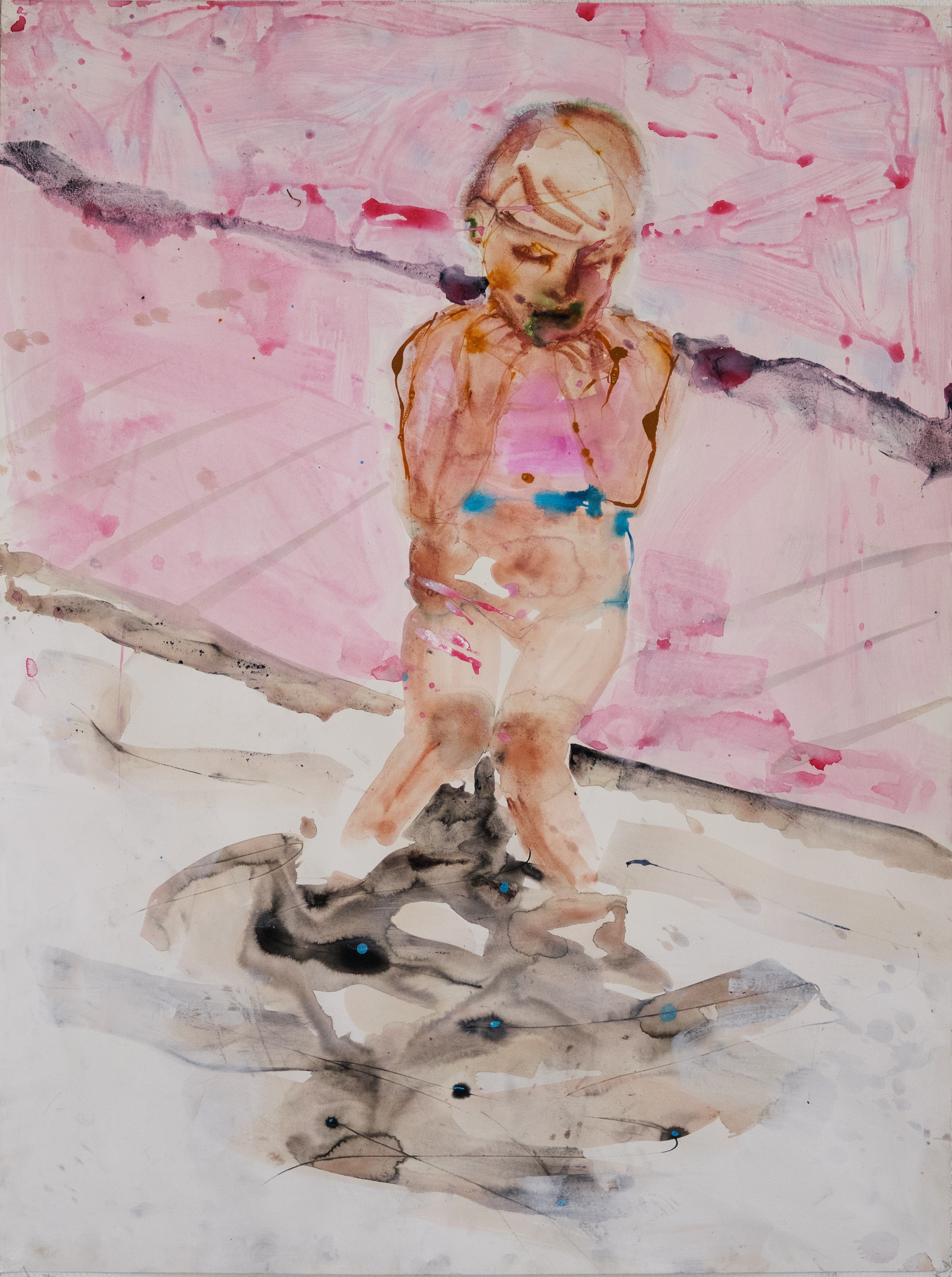
With Narcissus, the image itself becomes central.
The painting draws on Conon’s account rather than the more familiar version by Ovid. Narcissus repeatedly rejects Ameinias and finally sends him a sword. Ameinias kills himself outside Narcissus’s door, calling on the gods for revenge.
Later, Narcissus falls in love with his own reflection. When he reaches towards it, the image dissolves. He can see what he loves, but cannot reach it. What Ameinias experienced before him returns in another form.
The image makes absence visible: it can bring someone close while confirming that they cannot be reached. Presence and loss occupy the same image.
It can hold us to what is gone. For Narcissus, the image is a trap.
But an image can also console — not by restoring what has been lost, but by giving absence a form that can be carried.
When Narcissus dies, narcissus flowers grow where drops of his blood fall. The tragedy is not undone. Yet something new takes form from what cannot be changed.
Here Narcissus meets William Wordsworth’s Daffodils.
Wordsworth sees the flowers and moves on. Later, they return before his “inward eye”. What he saw has become an inner image.
The contrast is decisive. Narcissus cannot leave the image; Wordsworth can leave the place and carry the image with him. Because he is a poet, the image returns to the world as a poem.
This is a different kind of return from the one at the Hatter’s table. There, movement leads back to the same place. In Wordsworth, what returns has changed form.
The paintings exist between these possibilities. They hold a state in place while opening it to interpretation.
Art cannot undo what has happened or restore what has been lost. But it can alter the form in which an experience remains.
To be bound to an image is not the same as carrying one.
When the viewer leaves the gallery, the figures remain: The Katabast in his descent, The Cleancutter before the mirror, Narcissus at the water’s edge.
Their images leave with us.
Stefan Berger
About the Artist
Stefan Berger is a Swedish visual artist whose practice has developed at the intersection of painting, literature and theatre. His paintings and drawings explore existential questions through recurring figures and literary and mythological references. Drawing functions not only as a medium but also as a way of thinking, closely connected to the development of his paintings.
He has held solo exhibitions at Åland Art Museum and Teckningsmuseet in Laholm, and his work has been included in the Frost Art Museum’s The Drawing Project. He has also worked with scenography for Dramaten, Sweden’s Royal Dramatic Theatre.
The Katabast marks his first major solo exhibition in fourteen years, following a sustained period of artistic exploration and development.
Exhibition Information
Artist: Stefan Berger
Exhibition: The Katabast
Venue: Gallery OSTEN, Skopje, North Macedonia
Dates: 26 November–12 December 2026
Opening: 26 November 2026, 20:00
Curator: Kornelija Koneska
Part of: Official programme of the OSTEN Biennial
Press Images

Stefan Berger, The Cleancutter, 2026 (detail). Ink, acrylic and charcoal on paper, 120 × 90 cm.
Download high-resolution image.

Stefan Berger, Narcissus, 2026. Ink, acrylic and charcoal on paper, 120 x 90 cm.
Download high-resolution image.
OSTEN Biennal Skopje 2026
Stefan Berger participates in the OSTEN Biennial Skopje 2026 and has been selected for the ARTIST of EUROPE Award, presented by WAVA / OSTEN Biennial.
The official exhibition opening and awards ceremony will take place at the National Gallery, Chifte Hammam, Skopje, on 17 December 2026 at 19:00.
Press Contact
For press enquiries and additional material, please contact Stefan Berger:
stefan@stefanberger.se
For enquiries about the biennial and its programme, contact OSTEN :